


From environmental protection concepts to
Bamboo fiber paper straws that have passed quality control inspection
Where Sustainability Meets Premium Quality
Savoring Nature, Bamboo Brings Extraordinary Value
An eco-friendly choice that starts with a straw.
A video taken in 2015 by marine biologist Christine Figgener shows the rescue of a sea turtle whose straw got stuck in its nose.
The film quickly garnered global attention after its release, and this shocking imagery sparked reflection and action worldwide. Subsequently, more and more countries and regions decided to ban single-use plastic straws, with Seattle becoming the first city in the world to do so.
Taiwan and the Philippines also joined this environmental movement in 2019. In 2024, the world further promoted "plastic reduction" policies and planned to reduce plastic use by 60% by 2040.
【Virnova Bamboo Air Purifier】was created to meet the growing environmental demands, with the core concept of "quality and environmental protection coexisting" to provide consumers with an uncompromising alternative.

Let bamboo fiber paper straws go international
Virnova Bamboo Squeeze and GoldenKawayan from the Philippines are sister companies, sharing the same mission and vision to provide high-quality, durable bamboo fiber paper straws and jointly promote global plastic reduction efforts. We believe that environmental protection should not be confined to one region, but should be a transnational action. Through good products, we aim to allow more people to enjoy the pure experience of beverages while simultaneously contributing to the well-being of our planet.
Virnova bamboo fiber paper straw third-party inspection report
Virnova regularly conducts multiple third-party tests on its bamboo straws, including material analysis, plastic composition, PFAS, bisphenol A, plasticizers, SVHC, bio-based carbon content, and food utensils, containers and packaging related tests as regulated by the Ministry of Health and Welfare, providing food and beverage brands with a safer choice of paper straws.

SVHC test

PFAS test

BPA & PAEs testing

Plastic Inspection

Material inspection

Bio-based certification mark

Bio-based testing

TFDA Food Utensils, Containers, and Packaging Inspection | Fluorescent Whitening Agents & Heavy Metals Inspection
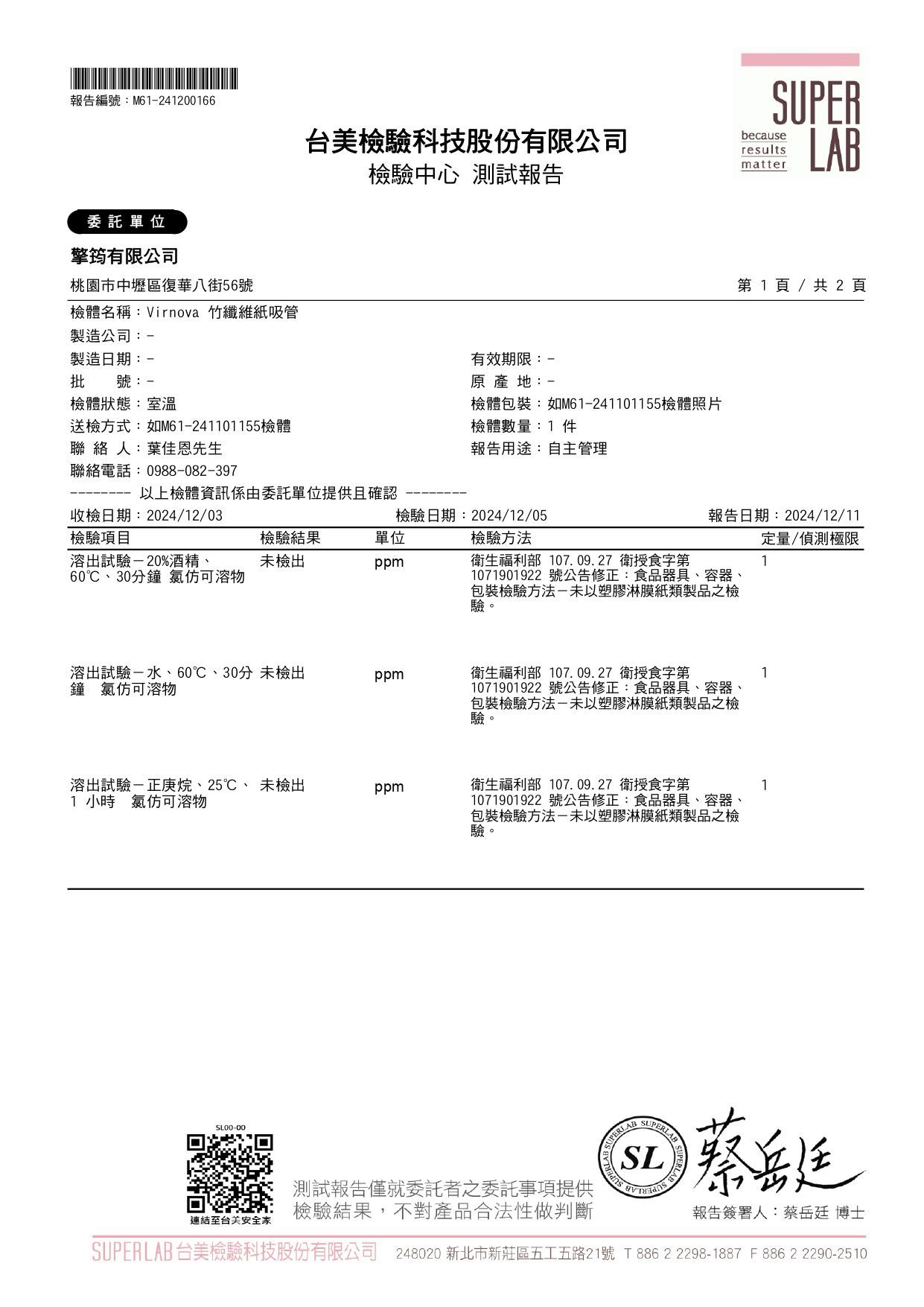
TFDA Food Utensils, Containers and Packaging Inspection | Chloroform-Soluble Matter Inspection
What do these test items represent? Understanding the safety standards for paper straws.
001
SVHC (Related to REACH Substances of Very High Concern)
Substances of Very High Concern refer to chemical substances that pose significant environmental and human toxicity and pose a high risk. The European Chemicals Agency (ECHA) selects these substances after review and evaluation, in accordance with Article 58 of the REACH (Registration, Evaluation, Authorization and Restriction of Chemical Substances) Regulation, which pertains to carcinogenic, mutagenic and reproductive toxicants (CMR substances), or substances that are persistent, bioaccumulative, toxic, highly persistent, highly bioaccumulative, or for which there is evidence of similar hazards (e.g., endocrine disruptors).
002
PFAS (per- and polyfluoroalkyl substances)
Per- and polyfluorinated alkyl substances (PFAS) have been a major concern in Europe and America for the past decade or so. PFAS are chemically stable and difficult to decompose, and easily accumulate in the environment. Due to their surfactant, waterproof, and oleophobic properties, they are widely used in food packaging materials. PFAS are endocrine disruptors, binding to receptors for thyroid hormones, estrogen, and leptin, and also affecting metabolism and the immune system; in terms of reproductive toxicity, they can affect the growth and development of the fetus during pregnancy and the infant during lactation.
003
BPA & PAEs (Bisphenol A & Plasticizers)
BPA is a common chemical raw material, used in polycarbonate (PC) plastics and also as a common material for can coatings. BPA can disrupt human hormones; some human epidemiological studies have found a link between BPA and type 2 diabetes and heart disease in adults, and it can also affect reproduction and development.
PAEs are a class of widely used plasticizers added to plastics to enhance their elasticity, transparency, durability, and lifespan. Current research largely indicates that PAEs have reproductive and developmental toxicity in laboratory animals. Regarding carcinogenicity, the International Agency for Research on Cancer (IARC) classifies DEHP as "possibly carcinogenic to humans" (Group 2B) and BBP as "not yet classified as carcinogenic to humans" (Group 3).
004
Plastic Inspection
While plastics offer excellent plasticity and water resistance, and are inexpensive, they are not biodegradable and can take hundreds of years to break down into smaller fragments or microplastics. These microplastics, once released into the environment, can be ingested by marine life and return to our lives through the food chain. Some studies suggest that long-term exposure to high concentrations of microplastics may lead to problems such as inflammation, oxidative stress, and immune and endocrine disruption; however, these effects require further scientific investigation. Therefore, reducing the use of single-use plastics is not only an environmentally friendly choice but also a preventative measure for our future living environment.
005
fluorescent whitening agent
Optical brighteners are chemicals commonly used to make paper appear whiter and brighter, and are frequently found in paper, textiles, and cleaning products. However, their safety and compliance must be carefully considered when used in packaging, containers, or tableware that come into direct contact with food. The migration of optical brighteners into food can raise food safety concerns. Improper exposure to some optical brighteners may cause symptoms related to skin and mucous membrane irritation or allergic reactions. Therefore, regulations concerning the use and migration safety of optical brighteners are in place by Taiwan's Ministry of Health and Welfare's "Hygienic Standards for Food Utensils, Containers, and Packaging" and the US FDA 21 CFR 176.170.
